
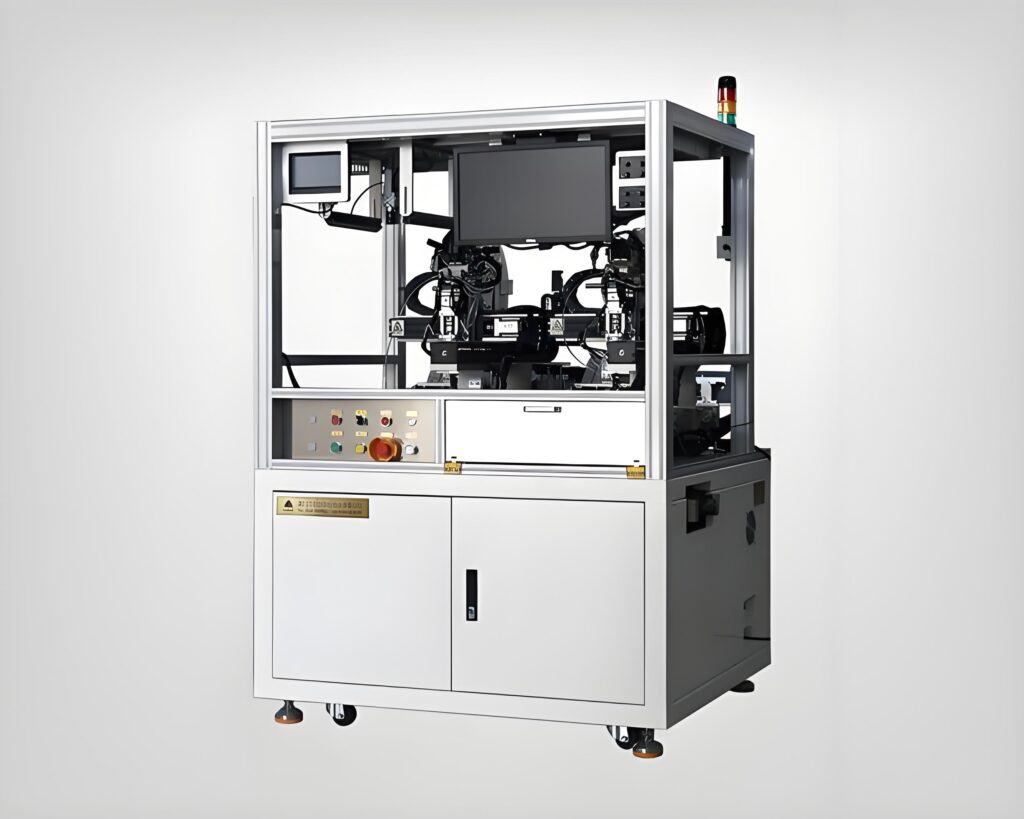
Meta Title: How to Choose the Right Automated Labeling Machine | ALM Automation
Meta Description: Not sure which labeling machine fits your production line? This guide breaks down the 6 key factors – from product type to throughput – and maps each one to the right ALM model.
Target Keywords: automated labeling machine selection, how to choose a labeling machine, vision labeling machine, labeling machine for electronics, industrial labeling machine
Suggested Category: Field Notes (fits across multiple categories – or create a new “Buyer’s Guide” category)
Introduction
Choosing the wrong labeling machine is expensive – not just in upfront cost, but in downtime, rework, and missed production targets. Yet many factories approach the selection process by looking at specs sheets alone, without first asking the right questions about their own production environment.
This guide takes a different approach. Before we talk about machines, we talk about your factory: what you’re labeling, how fast, how accurately, and what your line looks like today. Answer those questions clearly, and the right model becomes obvious.
Here’s what to evaluate – and how ALM’s lineup maps to each scenario.
1. What Are You Labeling? (Product Type & Surface)
The single biggest factor in model selection is the product itself.
Flat, regular surfaces – PCBs, flat IC packages, rigid plastic panels – are the easiest to label. Almost any vision labeler can handle them reliably.
Small electronic components fed loose or on reels need a machine specifically designed for high-speed, small-pitch placement with tight positional tolerance. The ALM-1000 (Open Type) and ALM-1500 (Closed Type) were built exactly for this: flexible vision alignment, compact footprint, and the ability to handle small components with ±0.1 mm accuracy.
Products arriving in trays – IC chips, semiconductor modules, medical components – require a different feeding mechanism entirely. The ALM-3000 Tray-Feeder Vision Automatic Labeler handles tray-based feeding natively, making it the natural choice for semiconductor and medical device lines.
Curved or irregular surfaces require specialized fixturing and sometimes multi-axis motion. If your product falls into this category, contact ALM directly for a custom application review before selecting a model.
Quick check: Can your product be placed flat and fed consistently? If yes, a standard vision labeler works. If it arrives in trays, you need a tray-feeder model.
2. How Fast Does Your Line Run? (Throughput Requirements)
Labeling speed is measured in units per hour (UPH) or cycle time per piece. Your labeling machine must keep pace with the upstream process – or it becomes the bottleneck.
- Low-to-medium throughput (single-shift, mixed-product lines): A single-nozzle vision labeler (ALM-1000 or ALM-1500) is sufficient and cost-effective.
- High-throughput production lines: The ALM-2500 Dual-Nozzle Dual-Feeder Vision Labeler runs two labeling heads simultaneously, effectively doubling output without doubling floor space. This is the right machine when UPH targets are aggressive and line stoppages are not an option.
- Fully unmanned, 24/7 operations: The ALM-4000 Spider-Robot Automatic Tray Handling System automates the tray transfer layer entirely – no operator intervention needed for loading, unloading, or repositioning between labeling cycles.
Quick check: Calculate your required UPH. If a single-head labeler can’t hit it with a 20% buffer, step up to a dual-head or automated handling system.
3. Do You Need Variable Data Printing? (Traceability Requirements)
Regulations in medical devices, automotive, and semiconductor supply chains increasingly require unit-level traceability: each part labeled with a unique serial number, batch code, or QR code generated at the moment of labeling.
A standard labeler applies pre-printed labels. That works when label content is fixed.
When label content changes per unit – serial numbers, timestamps, lot codes, inspection results – you need the ALM-3500 Real-Time Printing Vision Labeler. It integrates an on-demand printer directly into the labeling cycle, generating and applying each label in a single pass. No pre-printed label inventory. No mismatches between label stock and production batch.
If your factory is moving toward smart manufacturing or MES/ERP integration, the ALM-3500’s traceability-ready architecture makes it the forward-looking choice even if real-time printing isn’t required today.
Quick check: Does your labeling content change per unit, per batch, or per shift? If yes – or if it will within two years – choose the ALM-3500.
4. What Does Your Production Environment Look Like? (Open vs. Closed, Cleanroom)
The physical environment of your production line affects machine configuration.
Open-frame machines (ALM-1000, ALM-2500) are easier to access for maintenance, changeover, and integration into existing conveyor lines. They’re the right choice for general electronics manufacturing environments.
Closed-type machines (ALM-1500) provide a fully enclosed safety design with a cleanroom-friendly layout. If your line operates under ISO-classified cleanroom conditions – common in semiconductor packaging, medical device assembly, or precision optics – the closed design reduces contamination risk and meets facility requirements more easily.
Quick check: Do you operate under cleanroom or ESD-controlled conditions? If yes, specify the ALM-1500. If not, open-type machines offer better accessibility.
5. How Many Product Types Do You Run? (SKU Flexibility)
High-mix, low-volume production creates a different set of demands than high-volume, single-SKU lines.
When you’re labeling a single product at high speed, optimization is straightforward. When you’re switching between dozens of component types – different sizes, different label positions, different label SKUs – you need a machine that handles changeover quickly and reliably.
The ALM-2000 Piece-to-Piece Vision Labeler is designed for mixed-size production: its vision-based position correction adapts to product variation without mechanical re-fixturing. If your line runs frequent changeovers or handles a wide product mix, this flexibility reduces setup time and human error significantly.
Quick check: How many different product SKUs does your line label per week? More than 5–10 with significant dimensional variation? The ALM-2000’s adaptive vision system becomes a real operational advantage.
6. What Level of Automation Do You Need Upstream and Downstream?
A labeling machine doesn’t operate in isolation. The question isn’t just “which labeler?” – it’s “how does it fit into the broader production flow?”
If material handling between processes is still manual, adding automation upstream can unlock significant efficiency gains that dwarf the labeling machine’s own speed improvements. The ALM-4000 Spider-Robot Automatic Tray Handling System addresses this directly: it automates high-speed robotic tray transfer, connects labeling with upstream and downstream stations, and is specifically designed for unmanned production lines.
For factories currently using manual tray handling, the ALM-4000 is often the missing link that makes the rest of the line’s automation investment worthwhile.
Quick check: Is manual tray handling currently your production bottleneck? If yes, solve that first – or solve it simultaneously with labeling.
ALM Model Selection Summary
| Scenario | Recommended Model |
|---|---|
| Small components, flat surface, medium throughput | ALM-1000 (Open) or ALM-1500 (Closed) |
| Cleanroom / enclosed environment | ALM-1500 |
| High-mix, variable product sizes | ALM-2000 |
| High-throughput, dual-head production | ALM-2500 |
| Tray-fed products (IC, modules, medical) | ALM-3000 |
| Variable data / traceability / smart factory | ALM-3500 |
| Fully automated, unmanned tray handling | ALM-4000 |
The Right Process: Start With Your Production, Not the Spec Sheet
The factories that make the best equipment decisions follow a consistent process:
- Document your product – dimensions, surface type, feeding method, label placement requirements
- Define your throughput target – with a realistic buffer for line variation
- Check your compliance requirements – does your customer or industry mandate traceability?
- Assess your environment – cleanroom, ESD, open floor?
- Map your production mix – fixed SKU or high-mix?
- Look at the full line – where are the real bottlenecks?
Only after you’ve answered those questions should you be looking at machine specifications.
If you’ve worked through this list and still have questions about which ALM model fits your operation, our engineering team is available for a direct application consultation. We’ve deployed labeling systems across electronics, semiconductor, medical device, automotive, and industrial sectors – and in most cases, a 20-minute conversation is enough to narrow the choice to one or two clear options.