
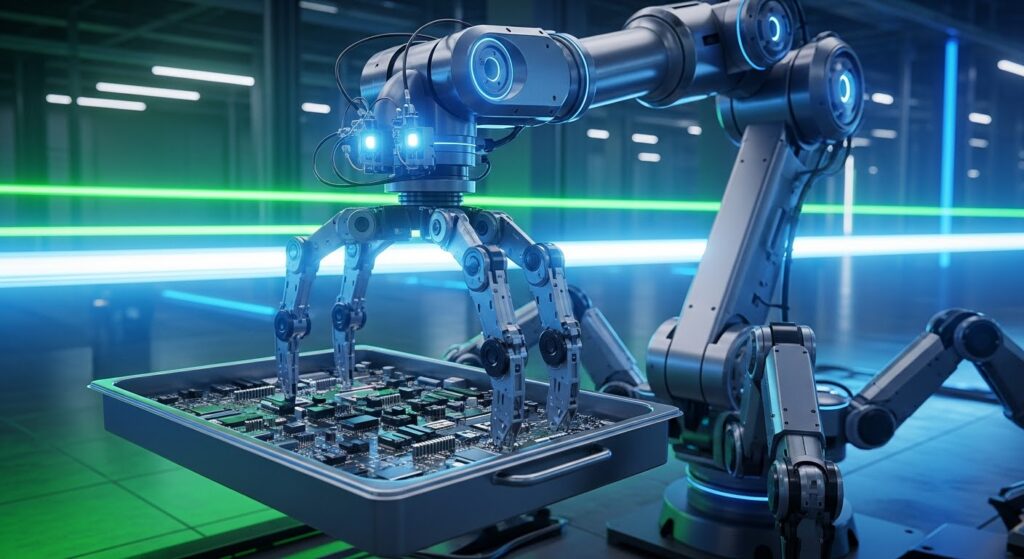
In the era of industrial automation advancing toward flexibility, intelligence, and high-speed operations, supply at the front end of production lines and packaging/palletizing at the back end have long been bottlenecks with heavy reliance on human labor. The Spider Robot Automated Palletizing System represents a disruptive solution to overcome this bottleneck. This paper avoids isolating the high-speed parallel robot (commonly known as the “spider arm”) and instead defines it as a high-end mechatronic system integrating high-speed parallel robots, intelligent vision recognition, precise pallet positioning, and adaptive control systems. The system emulates the speed, precision, and coordination of a spider in hunting, achieving high-speed, high-precision grasping and matrix-programmable placement of scattered, unordered, or organized materials onto pallets. This study deconstructs the system from multiple dimensions, including system philosophy, mechanical architecture, core workflow, technical advantages, and industrial applications. It reveals that the system functions not merely as a physical material handler but as an intelligent execution node that synchronizes information and material flows at millisecond scales. Its core value lies in the “three highs”—high speed, high precision, high flexibility—thoroughly reshaping production logic in packaging, sorting, and assembly. Through in-depth analysis of four typical scenarios—precision placement of 3C electronic components, high-speed food packaging, sterile pharmaceutical handling, and e-commerce order sorting—this paper demonstrates how the system enhances overall line OEE, ensures product consistency, and enables the vision of a “lights-out factory.” Finally, the paper prospectively discusses the system’s integration with digital twin, AI vision, and collaborative robot ecosystems, pointing out its evolution from a pre-programmed automated device to a production system end-effector with self-learning and adaptive capabilities.
Chapter 1: System Definition and Philosophy – Beyond “High-Speed Grasping” to a Collaborative Intelligent Agent
1.1 Redefinition: From “Spider Arm” to “Intelligent Palletizing System”
The industry term “spider robot” mainly refers to a high-speed parallel robot (Delta Robot), inspired by spatial parallel mechanisms. It employs multiple rigid arms (carbon fiber or aluminum alloy) connected between a fixed platform and a moving platform via ball joints or hook joints, driven by servo motors, enabling the end effector to move at high speed and acceleration in three-dimensional space. However, a complete “Automated Palletizing System” encompasses much more.
The Spider Robot Automated Palletizing System is fully defined as an automated workstation centered on a high-speed parallel robot, integrated with a high-frame-rate machine vision system, high-precision conveyor and pallet positioning mechanisms, flexible end-effectors (pneumatic/electric grippers, vacuum cups, etc.), and an intelligent control system. It can perform real-time recognition, positioning, and tracking of continuously or intermittently conveyed products and place them on pallets, trays, boxes, or conveyors in pre-set patterns (matrix, circular, or customized layouts) at high speed and precision. This achieves end-to-end automation from unordered/ordered input to structured, unitized pallet placement.
1.2 Core Operational Philosophy: Synchronization, Decoupling, and Reconstruction
The system’s operation embodies three modern precision automation philosophies:
- Spatiotemporal Synchronization: The vision system’s dynamic target recognition, robot trajectory planning, and end-effector actions (opening/closing, pick/release) must be strictly synchronized at the millisecond level. This relies on high-performance motion controllers and precise “hand-eye calibration” to seamlessly convert target coordinates in the vision system into robot motion commands.
- Process Decoupling: The system intelligently decouples tightly coupled processes of traditional production lines: “feeding – positioning – grasping – placing.” For example, the conveyor can run continuously or variably, the vision system tracks and locates without contact, the robot performs independent high-speed grasping, and the pallet system executes precise intermittent positioning. Each process runs in parallel under the control system, maximizing overall throughput.
- Order Reconstruction: The system transforms one spatial order (incoming material state) into another that is more suitable for downstream processing, transport, or sales (pallet matrix). This reconstruction often incorporates information binding (e.g., linking product IDs to pallet positions via code reading), laying the foundation for digital management.
Chapter 2: Deep System Architecture – The Mystery of Four Core Subsystems in Coordination
The exceptional performance of the Spider Robot Palletizing System stems from the precise coordination of four core subsystems.
2.1 High-Speed Parallel Robot Core: The Foundation of Speed and Precision
This is the system’s “body,” whose structure determines performance limits.
- Mechanical Principle: Typically consists of a fixed platform, moving platform, and 3-4 symmetrically distributed active and passive arms forming a spatial parallel closed-loop. The light end-effector minimizes inertia, allowing extreme acceleration (up to 15G+) and repeatability (±0.1mm).
- Drive and Transmission: High-performance AC servo motors with precision gearboxes (e.g., hollow shaft reducers) ensure smooth and precise output. Motors mounted on the fixed platform reduce moving mass.
- Workspace and Flexibility: The workspace approximates an inverted cone, ideal for rapid vertical pick-and-place operations. Advanced 4- or 6-axis parallel robots add rotation/translation axes on the moving platform, enabling complex grasping and placement tasks.
2.2 Intelligent Vision Guidance System: The “Eyes” and “Pilot” of the System
This subsystem defines whether the system can “see clearly, recognize accurately, and keep up.”
- Dynamic Vision Positioning: High-frame-rate industrial cameras (hundreds of fps) capture moving objects and compute trajectories for continuous pick-and-place (“flying pick”), significantly improving throughput.
- Multi-Type Recognition: Handles both organized and scattered materials. Advanced image processing algorithms (e.g., Blob analysis, deep learning segmentation) determine each object’s position and orientation for optimal grasping.
- Quality Inspection and Sorting: Integrated defect detection identifies damaged or dirty products before or after grasping, directing them to separate areas for online 100% inspection.
- Hand-Eye Calibration: Precisely maps camera pixel coordinates to robot world coordinates, ensuring visual guidance accuracy.
2.3 Precision Conveyor and Pallet Management System: The “Canvas” of Order
This subsystem carries the reconstructed order, where precision determines final placement quality.
- Conveyor System: Vibratory feeders, belts, or rollers deliver products at controlled speed and orientation. Stability is critical.
- Pallet Positioning and Supply:
- High-Precision Positioning: Servo-driven modules, cam dividers, or locating pins ensure pallet stopping accuracy (±0.05mm).
- Automatic Supply and Retrieval: Integrates empty/full pallet stacks, providing automated pick-and-place, minimizing manual intervention.
- Adaptive Pallet Handling: Compatible with multiple pallet types, automatically selecting the appropriate program via quick-change devices or vision recognition.
2.4 Intelligent Control System: The “Brain” and “Nervous System” of Coordination
This is the command center coordinating all subsystems in milliseconds.
- Multi-Task Real-Time Scheduling: Processes vision streams, robot kinematics, multi-axis interpolation, conveyor encoder signals, and I/O interactions in parallel. PC-based soft motion controllers or high-performance motion cards ensure millisecond-level cycles.
- Trajectory Planning and Optimization: Calculates time-optimal, energy-optimal, and collision-free paths, especially crucial for multi-robot coordination.
- Adaptive and Fault-Tolerant Logic: Handles anomalies such as failed grasps, full pallets, or abnormal input, executing recovery routines.
- HMI and Data Interfaces: Graphical programming interface for drag-and-drop layout design; open protocols (OPC UA, Modbus TCP) connect to MES/ERP systems, reporting production counts and status.
Chapter 3: Core Technical Features and Overwhelming Advantages
Compared to traditional palletizing methods (manual, multi-joint robots, dedicated machines), the Spider Robot System offers generational advantages in multiple dimensions.
3.1 Extreme Speed and Cycle Advantages
The parallel structure and lightweight end-effector enable pick-and-place cycles of hundreds per minute (e.g., 150–300/min), far exceeding conventional multi-joint robots (60–120/min). One unit can replace multiple traditional robots or workstations, greatly increasing throughput.
3.2 Exceptional Precision and Consistency
High-rigidity parallel structure and precision servo control achieve ±0.1mm repeatability, ensuring consistent placement for precision components or packaging, eliminating fatigue and human error, enhancing product quality and downstream automation reliability.
3.3 Unmatched Flexibility and Programmability
- One-Click Changeover: Switch products or pallet types in minutes via HMI template selection without hardware changes.
- Arbitrary Pattern Programming: Matrix, circular, staggered, or custom patterns are easily defined in software.
- Mixed Palletizing: Different SKUs can be placed on the same pallet per visual recognition, supporting flexible order assembly.
3.4 High Integration and Space Efficiency
Ceiling-mounted installation maximizes upper workspace; conveyor and pallet systems occupy lower space. One unit can cover large areas efficiently.
3.5 Reliability and Low Maintenance
Fully electric drive, few moving parts, simple structure. Capable of 24/7 operation with stable output; modular design reduces maintenance complexity and cost.
Chapter 4: In-Depth Analysis of Typical Application Scenarios
4.1 Scenario 1: Precision Placement of 3C Electronic Components
- Objects: Chips, capacitors, resistors, connectors, smartphone components.
- Challenges: Small, precise, fragile, multiple batches, strict packaging (anti-static, orientation-specific).
- Solution: Spider robot uses micro vacuum or grippers, guided by high-definition vision, to place components with ±0.1mm accuracy into anti-static trays or foam nests, performing dual-side inspection and counting.
- Value: Replaces microscope labor, increases efficiency 5–10x, reduces damage rate by order of magnitude, enables standardized and traceable SMT front-end automation.
4.2 Scenario 2: High-Speed Secondary Food Packaging
- Objects: Chocolates, cookies, candies, frozen foods.
- Challenges: Hygiene compliance, high speed, diverse packaging.
- Solution: Food-grade spider robot rapidly and accurately picks single items into pre-set trays/boxes, integrates weighing and metal detection downstream.
- Value: Resolves labor shortages, ensures hygiene, matches upstream line speed, greatly improves throughput.
4.3 Scenario 3: Sterile Pharmaceutical Placement
- Objects: Vials, ampoules, prefilled syringes, blister packs.
- Challenges: Extreme sterility, no damage/contamination, batch traceability.
- Solution: Operates in cleanroom or isolator, gently places products in sterilized pallets, logs product-to-pallet mapping, integrates with MES, meets GMP/FDA standards.
- Value: Minimizes human contact, reduces contamination, ensures digital auditability, key to pharma Industry 4.0.
4.4 Scenario 4: E-Commerce Order Sorting and Consolidation
- Objects: High-SKU retail items.
- Challenges: Fragmented orders, high accuracy and speed, labor costs.
- Solution: “Goods-to-Robot” system picks multiple items into order boxes or bins per visual recognition.
- Value: Automates order sorting, exceeds manual efficiency and accuracy, essential for peak periods, lowers logistics fulfillment costs.
Chapter 5: Future Outlook – From Automated Execution to Cognitive Collaboration
The Spider Robot Automated Palletizing System will continue evolving:
- AI-Enhanced Vision: Deep learning predicts optimal pick sequence and compensates for product deformation dynamically.
- Digital Twin & Virtual Commissioning: Entire workstation simulated virtually for zero physical trial deployment.
- Human-Robot Collaboration: Lightweight, force-controlled robots share workspace with humans safely; humans handle complex feeding/exception handling, robots perform repetitive high-speed palletizing.
- Swarm Intelligence: Multi-robot “hive” coordinated by central AI distributes tasks dynamically for ultra-large or complex patterns.
- Cloud and Lifecycle Management: Equipment data uploaded to the cloud for remote monitoring, predictive maintenance, and process optimization; transforms devices from “products” to “services.”
Conclusion
The Spider Robot Automated Palletizing System represents an advanced form of automation that perfectly integrates extreme motion performance, real-time environmental sensing, and intelligent decision-making control. It has evolved from simple labor-replacing manipulators to intelligent production units capable of self-directed complex order reconstruction in dynamic environments. Its value lies not only in labor reduction, speed, and precision but also in providing a highly flexible, standardized interface that seamlessly connects chaotic back-end production with organized logistics and warehousing.
With personalized customization, rapid changeover, and zero-defect quality becoming standard expectations, the system’s “high-speed, high-precision, high-flexibility” characteristics make it a critical tool for overcoming the final bottleneck of smart manufacturing. For enterprises aiming to build agile supply chains and intelligent factories, investing in and deploying this system is not just a practical step for current production enhancement but a strategic move to establish a resilient production system and reinforce the digital-physical foundation for future growth. As AI and robotics continue to converge, this “steel spider” will weave increasingly intelligent, efficient, and adaptive modern manufacturing networks, solidifying its position as a core high-end automation technology.