
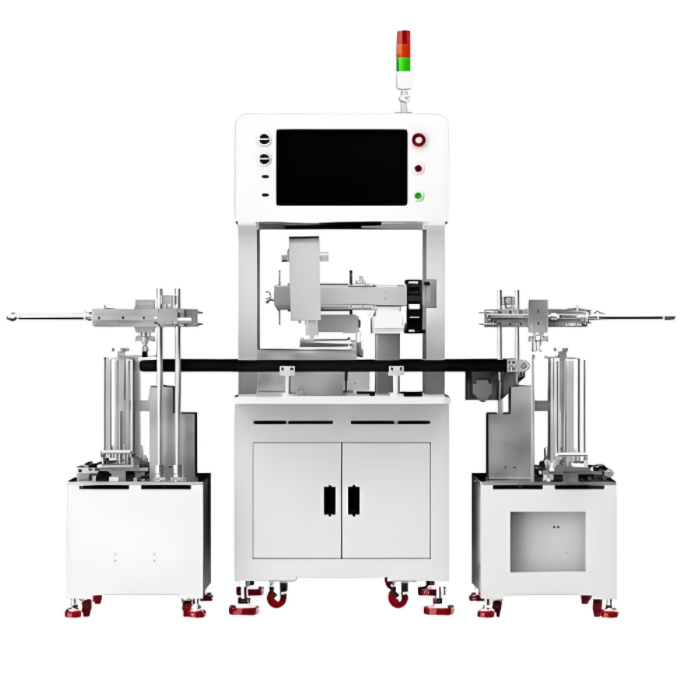
The Eye of Vision, the Intelligence of Precision: How Vision Labeling Machines Are Reshaping Accuracy and Efficiency in Modern Industry
In modern factories filled with precision equipment, vision labeling machines operate with accuracy beyond human eyesight and with tireless efficiency, applying labels to products one after another. These labels are no longer merely carriers of product information; they have become critical nodes connecting production, logistics, sales, and even end consumers.
The widespread adoption of vision labeling machines marks a profound transformation in industrial manufacturing—from mechanization and automation toward true intelligence. Their applications now span nearly every sector, from food and beverage to biopharmaceuticals, from consumer electronics to aerospace, making them indispensable “intelligent eyes” and “dexterous hands” of modern manufacturing.
I. Technical Foundation: Principles and Core Advantages of Vision Labeling Machines
At the heart of a vision labeling machine lies the deep integration of machine vision technology with precision mechanical control. Its workflow can be summarized as follows: when a product arrives at a designated station, an industrial camera rapidly captures its image. The vision processing system—typically powered by high-performance processors and advanced image algorithms—analyzes the image to accurately identify the product’s position, orientation, and even surface characteristics.
Based on feedback from the vision system, the control system then calculates and dynamically adjusts the motion trajectory of the labeling head, driving servo motors or robotic actuators to apply the label precisely at the predefined location. This entire process is completed within milliseconds, forming a closed-loop cycle of “perception–decision–execution.”
Compared with traditional labeling methods, the transformative advantages of vision labeling machines are clear:
- Ultra-High Accuracy and Consistency
Vision systems achieve sub-millimeter or even micron-level positioning accuracy, completely eliminating errors caused by manual operation or simple mechanical positioning. Every label is placed with consistent position and angle, meeting the stringent appearance requirements of high-end products. - Strong Adaptability to Complex Scenarios
Whether products are regular or irregular in shape, whether their positions on conveyors are fixed or random, or whether surfaces are curved or textured, advanced vision algorithms can identify and compensate accordingly. For example, cylindrical containers can be labeled with automatically calculated wrap paths, while uneven surfaces can be handled using 3D vision or specialized lighting to ensure flat adhesion. - Outstanding Flexibility and Intelligence
Through software configuration, labeling programs can be switched rapidly to accommodate different products, enabling true multi-product capability on a single machine. Combined with OCR (Optical Character Recognition) and OCV (Optical Character Verification), the system not only applies labels but also reads and verifies label content in real time, or inspects characters and graphics on the product itself—effectively preventing mislabeling or missing labels. - Significant Cost Efficiency and Traceability
Over time, vision labeling machines dramatically reduce costs associated with rework, scrap, and customer complaints caused by labeling errors. Meanwhile, precise labeling data integrated with MES and ERP systems provides a robust data foundation for full product lifecycle traceability.
II. Across Industries: The Expanding Application Landscape of Vision Labeling Machines
The application of vision labeling machines has formed a vast, interconnected network whose breadth and depth continue to expand.
(1) Food, Pharmaceuticals, and Life Sciences: Guardians of Safety and Compliance
This is one of the most mature application fields, with the strictest regulatory requirements.
- Food & Beverage Industry
On high-speed filling lines, vision labeling machines handle various container types (glass, PET, metal cans), ensuring production dates, expiration dates, batch numbers, nutrition labels, and QR codes are clearly printed and consistently positioned. Examples include ultra-precise top labeling on yogurt cups to avoid sealing areas, or side labeling on metal cans where reflective surfaces must be managed. Agricultural traceability labels are also widely applied. - Pharmaceuticals & Medical Devices
Accuracy here is virtually non-negotiable. Vision labeling machines must precisely apply labels to primary packaging and ensure that regulatory codes, UDI identifiers, dosage instructions, and warnings on secondary packaging and cartons are error-free. For medical devices—such as surgical kits or implant packaging—labels are critical to sterilization records, expiration dates, and traceability. Vision systems are often tightly integrated with verification systems to ensure full compliance across personnel, equipment, materials, methods, and environments. - Cosmetics & Personal Care
Appearance is a core competitive factor. Vision labeling machines achieve flawless label placement on refined bottles, jars, and tubes while ensuring regulatory information such as ingredient lists remains accurate. Promotional packs and gift sets often require complex multi-label applications, which vision systems handle with consistency and speed.
(2) Electronics & Semiconductors: Pushing the Limits of Precision and Miniaturization
The electronics industry evolves rapidly, with extreme precision requirements and miniature components.
- Consumer Electronics
Inside smartphones, tablets, and laptops, countless micro-components—PCBs, batteries, camera modules—require tiny labels containing serial numbers, specifications, and safety certifications. Vision labeling machines operate with ultra-high precision in confined spaces and adapt to diverse materials such as plastic, metal, and silicone. - Semiconductors & Electronic Components
Wafer carriers, chip trays, and discrete components rely on labels for batch tracking, performance identification, and logistics management. These labels are often extremely small and must be applied in ESD-safe and cleanroom environments, making vision system stability and cleanliness compatibility critical. - Home Appliances & Industrial Equipment
From air-conditioning compressors to industrial controllers, products and core components require durable, legible labels for manufacturing control, after-sales service, and maintenance traceability. Vision labeling machines handle metal and plastic surfaces alike, ensuring adhesion durability under heat, oil, and harsh operating conditions.
(3) Automotive & Aerospace: Rigid Demands for Reliability and Traceability
These heavy industries demand the highest standards of reliability.
- Automotive Manufacturing
From engines and transmissions to wiring harnesses and sensors, every stage depends on labeling. Vision labeling machines apply VIN labels, part serial numbers, and logistics identifiers. In smart factories, these labels interact in real time with production systems, guiding assembly processes and forming the foundation of full vehicle lifecycle data. - Aerospace
Safety and traceability requirements reach absolute extremes. Every aerospace component—from fasteners to turbine blades—must carry a unique identifier. Vision labeling machines ensure precise and durable application of specialized metal plates or high-temperature-resistant labels under harsh industrial conditions, supporting long-term readability for airworthiness certification and maintenance records.
(4) Logistics & Supply Chains: Engines of Efficiency and Transparency
The explosive growth of e-commerce and global trade has made logistics centers prime arenas for vision labeling technology.
- Warehousing & Sorting Centers
On automated sorting lines, vision labeling machines print and apply shipping labels, delivery labels, and picking slips in real time based on order data. They intelligently identify parcel dimensions and optimal labeling surfaces, dynamically adjusting placement to maximize speed and accuracy—making them core equipment for unmanned warehouses and lights-out factories. - Manufacturing Execution & WIP Management
In flexible manufacturing systems, vision labeling machines apply work-in-process labels containing routing and process status data, enabling transparent production tracking and real-time scheduling.
(5) Emerging and Niche Applications
- New Energy
In lithium battery production, cells, modules, and battery packs require labels containing voltage, capacity, and batch data. Vision systems ensure precise and safe operation in hazardous environments. - Publishing & Archives
Automatic application of anti-theft strips, catalog labels, and ISBN barcodes improves automation in libraries and publishing houses. - Furniture & Building Materials
Labels containing specifications, materials, and environmental ratings are applied to panels and profiles, supporting Industry 4.0 adoption in mass customization.
III. Convergent Evolution: Technology Trends and Future Boundaries
Vision labeling machines continue to evolve alongside related technologies:
- Deep Integration of AI and Machine Learning
Traditional vision relies on fixed rules, while AI-driven systems learn from data, improving robustness in complex or highly variable scenarios such as natural product surfaces. - 3D Vision Becoming Standard
While 2D vision has limitations in height variation and curved surfaces, 3D vision technologies—such as structured light and laser triangulation—enable true three-dimensional labeling, particularly valuable in automotive and furniture industries. - Software-Hardware Integration and Cloud Connectivity
Machines are no longer isolated. Labeling data and equipment status are uploaded to cloud or industrial IoT platforms, enabling remote monitoring, predictive maintenance, and data-driven process optimization. - Flexibility and Modular Design
To support high-mix, low-volume production, vision labeling machines are becoming increasingly modular, allowing rapid reconfiguration of vision modules, labeling heads, and robotic units through software-defined functionality.
IV. Challenges and Outlook
Despite strong prospects, challenges remain: image stability under extreme lighting or reflective conditions, real-time response on ultra-high-speed lines, initial investment costs for SMEs, and the need for deep process knowledge when crossing industries.
Yet these challenges drive innovation. Looking ahead, vision labeling machines will evolve beyond simple labeling devices into integrated product information enablement terminals, combining precision perception, intelligent decision-making, and flexible execution. Their integration with robotics, IoT, and digital twins will further support transparent, flexible, efficient, and traceable smart factories and supply chains.
From ensuring medication safety to tracing the lifecycle of a semiconductor; from accelerating parcel throughput to empowering intelligent automotive manufacturing—vision labeling machines quietly but decisively permeate modern industry. They are not merely products of technological progress but catalysts of industrial upgrading, precisely annotating our era’s pursuit of quality, efficiency, and intelligence. As the narrative of industrial intelligence unfolds, this “eye of vision” will continue to see more clearly, and those “dexterous hands” will continue to create value—together shaping a more precise, efficient, and interconnected future of manufacturing.
Conclusion
If your industry is experiencing:
- Increasing product complexity
- Rising compliance pressure
- Growing labor costs
Then vision labeling is likely no longer a question of “whether,” but “when.”
📺 For real equipment demonstrations and application cases, visit our YouTube channel:
👉 https://www.youtube.com/@almautomation