
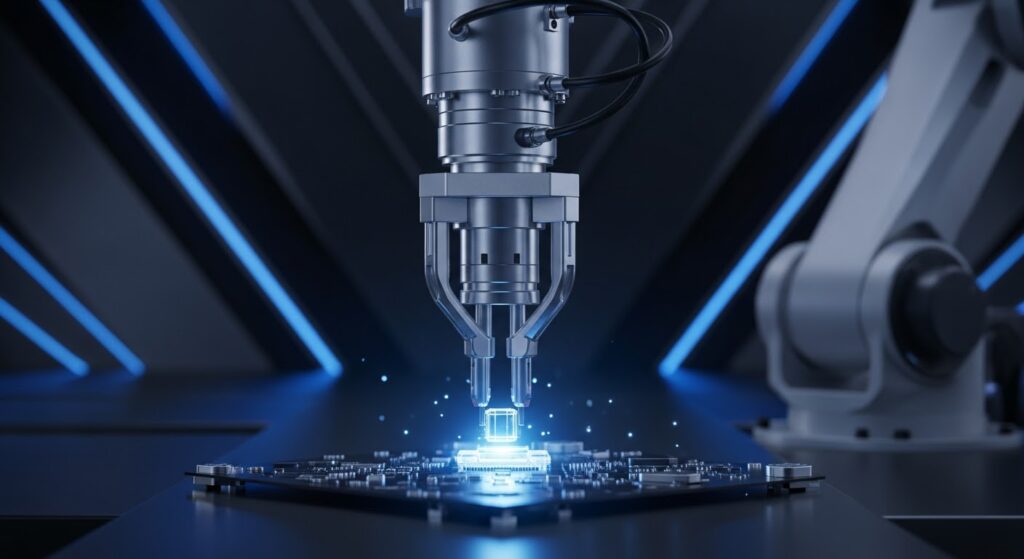
Abstract: In the wave of smart manufacturing and Industry 4.0, product identification and traceability have become critically important. The flexible single-nozzle vision labeling machine, as a core equipment on modern automated production lines, is reshaping product labeling operations with its high precision, flexibility, and intelligence. This article systematically outlines the technical system of flexible single-nozzle vision labeling machines, delves into their working principles, core modules, key technological elements, application advantages, typical use cases, and future development trends, aiming to comprehensively demonstrate the core value and profound impact of this technology in modern industry.
1. Introduction: Evolution of Labeling Technology and the Demand for Flexibility and Intelligence
Product labeling—including barcodes, QR codes, text, and graphic labels—is a critical link connecting production, logistics, sales, and consumption. It not only carries product information and brand identity but also serves as an essential vehicle for full-lifecycle traceability, anti-counterfeiting, and supply chain management. Traditional labeling methods, such as manual labeling, semi-automatic labeling, and early rigid automatic labeling machines, generally suffer from low efficiency, manual-dependent precision, limited adaptability to varying products or curved surfaces, and lack of quality self-inspection.
With the rapid shift of consumer markets toward diversified, small-batch, and customized products, along with high requirements for smart manufacturing posed by national strategies like “Made in China 2025,” production lines must quickly adapt to product changeovers and efficiently handle complex labeling tasks. Against this backdrop, the flexible single-nozzle vision labeling machine has emerged. It integrates precision mechanical transmission, servo control, machine vision, and intelligent software algorithms, achieving a leap from “manual visual” or “fixed program” operations to “vision-guided, intelligent decision-making, and adaptive execution,” becoming an indispensable key device in flexible manufacturing units and intelligent production lines.
2. Core Definition and Technical Features of Flexible Single-Nozzle Vision Labeling Machines
Flexibility: Refers to the machine’s ability to handle products of varying sizes, shapes, and materials, and perform labeling on different positions and surfaces (cylindrical, spherical, or irregular), with product changeovers requiring only software program calls and minimal or no mechanical adjustments.
Single Nozzle: Indicates that the labeling execution unit uses a single independent label pick-and-place mechanism (commonly called a “label head” or “label arm”), integrating label peeling, vacuum adsorption, and precise alignment functions. Compared to multi-nozzle parallel designs, a single-nozzle structure achieves high precision while offering higher cost efficiency and spatial flexibility.
Vision: Serves as the system’s “eyes” and “brain.” Industrial cameras capture product and label positions in real time. Image processing algorithms analyze the data, guiding the label head for precise positioning and orientation adjustments, and can automatically inspect labeling quality after application.
Core Technical Features:
- High Precision and Stability: Vision positioning accuracy can reach ±0.1 mm or higher, with servo systems ensuring smooth and precise motion.
- Strong Adaptability: Software parameter adjustments allow rapid adaptation to new products, labels, and positioning requirements.
- Intelligent Correction and Compensation: The vision system automatically detects product positional deviation and angular misalignment, guiding the label head for dynamic compensation.
- Online Quality Inspection: Integrated vision inspection can automatically detect label presence (missing labels), position accuracy, wrinkles, bubbles, and other defects.
- Easy Integration and Networking: Supports standard industrial communication protocols (e.g., Ethernet/IP, Profinet, Modbus TCP), facilitating integration into MES, ERP, and other higher-level management systems for data connectivity.
3. System Components and Working Principle
A complete flexible single-nozzle vision labeling machine is a complex mechatronic-optical integrated system, primarily composed of the following core modules:
1. Frame and Conveying Module
Serving as the physical foundation, typically constructed with high-rigidity aluminum profiles or steel structures to ensure stability and reduce vibration impact on precision. The conveying module can be a belt conveyor, chain conveyor, roller conveyor, or custom fixture pallet, depending on product shape, equipped with precise positioning devices (e.g., stops, servo positioning modules) to ensure repeatable product positioning for imaging and labeling stations.
2. Vision System Module
The core of “flexibility” and “intelligence.”
Hardware Components:
- Industrial Cameras: High-resolution, high-frame-rate CCD or CMOS cameras. Depending on the application, multiple cameras may be configured: one for product feature localization (top camera, mounted above the label head or independently fixed) to identify the labeling area; another for label correction (bottom camera, installed inside the label head or near the peel plate) to verify position and angle after label peeling, ensuring secondary precise alignment. Some high-end machines also include 3D cameras for curved surfaces or products with height differences.
- Industrial Lenses: Selected for focal length, depth of field, and resolution to ensure clear imaging and sufficient field of view.
- Lighting System: Critical for quality imaging. LED light sources of different angles, colors (red, blue, white), and structures (ring light, line light, coaxial light, backlight) are chosen based on product surface properties (reflective, absorptive, color, texture) and label features to highlight targets and suppress background interference.
Software and Algorithms:
- Image Acquisition and Preprocessing: Capture raw images, perform denoising, enhancement, and contrast adjustment.
- Feature Extraction and Localization: Advanced algorithms such as template matching (NCC-based, shape-based PatMax), blob analysis, edge detection, and contour finding quickly and accurately identify product reference points (edges, holes, printed marks) or labeling areas.
- Coordinate Calculation and Transformation: Features identified in the image coordinate system are accurately converted to the robot/world coordinate system using camera calibration, calculating target positions and rotation angles for the label head.
- Inspection Algorithms: Evaluate post-labeling quality against preset standards.
3. Labeling Execution Module (Single-Nozzle Unit)
- Label Head: The core actuator, integrating label peeling, vacuum suction (nozzle or plate), flexible floating mechanisms (spring or cylinder buffers for minor surface irregularities), and precision rotary motors for angle adjustment.
- Label Feeding System: Usually an active unwinding mechanism with label roll, tension control, traction motor, and peel plate. Labels peel at the sharp edge and are picked up by the label head.
- Motion Mechanism: Drives the label head along X, Y, Z, and rotational axes. Common types:
- Cartesian/Gantry Robots: Simple structure, high rigidity, large coverage, suitable for high-speed, large-range applications.
- SCARA Robots: Fast horizontal movement, high precision, suitable for compact spaces.
- Six-Axis Articulated Robots: Maximum flexibility for complex spatial trajectories, ideal for multi-faceted or irregular surfaces.
4. Control System Module
The “central nervous system” of the equipment.
- Core Controller: High-performance PLC or industrial PC coordinating module timing, processing vision data, executing motion algorithms, and managing I/O.
- Servo Drive System: Provides precise torque, speed, and position control.
- Human-Machine Interface (HMI): Graphical interface for parameter setting, program editing, production monitoring, alarm handling, and data statistics.
- Communication Interface: Facilitates data exchange with other production line devices and factory systems.
Working Process Summary:
- Product Positioning: Conveyors deliver products to imaging or labeling stations, and positioning devices ensure precise placement.
- Vision Localization: Top camera captures product image, system identifies reference features, calculates actual coordinates and angular deviation (ΔX, ΔY, Δθ) of the labeling area.
- Label Preparation and Correction: Label head moves to peel plate, picks up pre-peeled label. Bottom camera (if present) inspects label position and angle, ensuring accuracy.
- Dynamic Compensation and Application: Control system combines product and label deviations to generate the label head trajectory. Label head applies label smoothly with the floating mechanism, ensuring bubble-free adhesion even on slightly uneven surfaces.
- Quality Recheck (Optional): Camera inspects applied label for position, content (via code reading), and appearance; defective items are marked or rejected.
- Product Release: Completed products are conveyed to the next process.
4. Key Technical Elements and Challenges
- High-Precision Vision Positioning: Achieving stable, fast, sub-pixel feature localization under complex lighting, reflective surfaces, and background interference relies on advanced image processing, optimal lighting, and precise camera calibration.
- Multi-Coordinate System Calibration and Hand-Eye Coordination: Establishing accurate mapping between camera, robot, tool, and conveyor coordinate systems. Dynamic labeling requires real-time synchronization of vision and motion, demanding high computational and control performance.
- Complex Surface Adaptive Labeling: Applying labels flatly on cylinders, spheres, or free-form surfaces requires precise deformation and trajectory calculation, possibly using 3D vision for point cloud acquisition.
- High-Speed, High-Precision Motion Control: Label head must accelerate, decelerate, and position accurately in very short cycles while maintaining stability to prevent misalignment or product tipping, requiring optimized motion algorithms and high-performance servo systems.
- Software Usability and Openness: Encapsulating complex vision, motion, and logic controls into simple parametric interfaces reduces operator skill requirements. Open interfaces allow secondary development and third-party system integration, enhancing competitiveness.
5. Application Advantages and Typical Use Cases
Advantages:
- Enhanced Productivity: Automated labeling far exceeds manual speed and allows 24/7 operation.
- Consistent Quality: Extremely high positional accuracy and uniformity eliminate manual errors.
- Reduced Costs: Less reliance on skilled labor, lower rework, scrap, and complaint losses.
- Increased Production Flexibility: Quick changeovers support mixed-product lines, enabling flexible manufacturing.
- Traceability: Automatic inspection and data upload provide reliable sources for quality tracking.
Typical Applications:
- Electronics: Smartphones, tablets, laptops, wearables, power adapters—nameplates, information, and anti-counterfeit labels, often on curved surfaces.
- Home Appliances: Refrigerators, washing machines, ACs, small appliances—energy labels, parameter labels, barcodes.
- Automotive Components: Engines, transmissions, harnesses, sensors—traceability codes, model labels, often in harsh environments.
- Pharmaceuticals & Medical Devices: Medicine boxes, medical equipment—instruction labels, UDI codes, requiring cleanliness and high precision.
- Food & Beverage: Bottles, cans, boxes—production dates, shelf life, batch numbers, promotional labels; high speed and diverse materials.
- Logistics & E-Commerce: Parcel waybills, courier bag labels; high throughput and speed.
6. Future Development Trends
- Deep Integration of AI: Deep learning for robust feature recognition, defect detection, and classification, reducing template dependency and enabling self-learning.
- 3D Vision Adoption: Affordable 3D cameras and mature algorithms will standardize complex surface and stacked product labeling.
- Higher Speed and Smaller Footprint: Lightweight, rigid structures and faster processors will drive compact, high-speed machines.
- Improved Human-Machine Collaboration and Usability: Cobots enhance flexible, safe deployment; AR can assist debugging and maintenance; graphical, drag-and-drop programming simplifies operation.
- Cloud Platforms and Digital Twins: Cloud connectivity enables remote monitoring, predictive maintenance, and capacity optimization; digital twins allow simulation, debugging, and optimization in virtual environments.
- Multi-Function Integration: Machines may combine labeling with laser coding, vision reading, weight checking, and packaging, becoming intelligent workstations.
7. Conclusion
The flexible single-nozzle vision labeling machine is both a microcosm and an outstanding representative of modern industrial automation and intelligence. By organically integrating precision mechanics, advanced vision, and intelligent control, it addresses the pain points of traditional labeling, supporting quality improvement, efficiency enhancement, cost reduction, and flexible production. With the continuous penetration of AI, IoT, and other next-generation information technologies, its intelligence and application scope will further expand. Deep understanding and mastery of this technology are crucial for equipment manufacturers to enhance competitiveness and for manufacturers to advance smart production. It is foreseeable that flexible single-nozzle vision labeling machines will continue to act as “calibrators” on intelligent production lines, playing an increasingly critical role in the transition from “manufacturing” to “smart manufacturing.”