
Vision-controlled labeling for stable, repeatable production
This vision-guided labeling platform is designed for manufacturers requiring
high placement accuracy, controlled adhesive handling, and consistent output
in electronic and precision-product environments.
The system combines automated label feeding, multi-axis motion control,
and dual-camera vision alignment to deliver predictable labeling performance
across varying product types and production conditions.
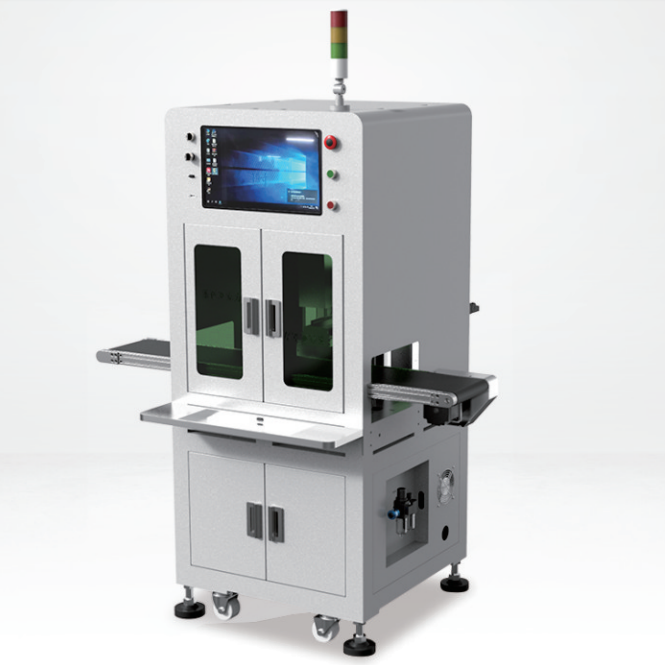
The platform supports a broad range of adhesive-based applications,
particularly in scenarios where precise visual alignment and placement
consistency are critical to product quality.
- 3C electronics and consumer electronics assemblies
- Electronic auxiliary material placement
- Back-adhesive film application
- Pressure-sensitive label placement
Labels are automatically fed and peeled from the feeder onto a non-stick
buffer surface, awaiting pickup by a precision nozzle.
A four-axis motion system performs automated pickup and placement.
A bottom-mounted vision camera detects real-time adhesive position,
while a top-mounted camera identifies product placement coordinates.
Proprietary algorithms calculate positional offsets and apply closed-loop
correction before placement, achieving placement accuracy of up to
±0.05 mm with stable process performance.
| Placement Yield | ≥ 99.5% |
| Process Scrap Rate | ≤ 1% |
| Operational Stability | ≥ 95% |
| Throughput Range | 1,500 – 2,000 units/hour |
| Mechanical Platform |
Precision ball screw and linear guide system (HIWIN / TBI), Y-axis upgradeable to linear motor configuration |
| Drive & Motion | Multi-axis servo and closed-loop stepper architecture |
| Vision Hardware | Dual industrial vision cameras (6–20 MP) |
| Control Software | Integrated motion and vision control software platform |
| Industrial Computing | Industrial PC, Intel® Core™ i5 class |
The platform is engineered to prioritize process stability, visual accuracy,
and long-term operational reliability.
Each subsystem is selected and integrated to support repeatable production
performance while allowing flexibility for future automation upgrades.